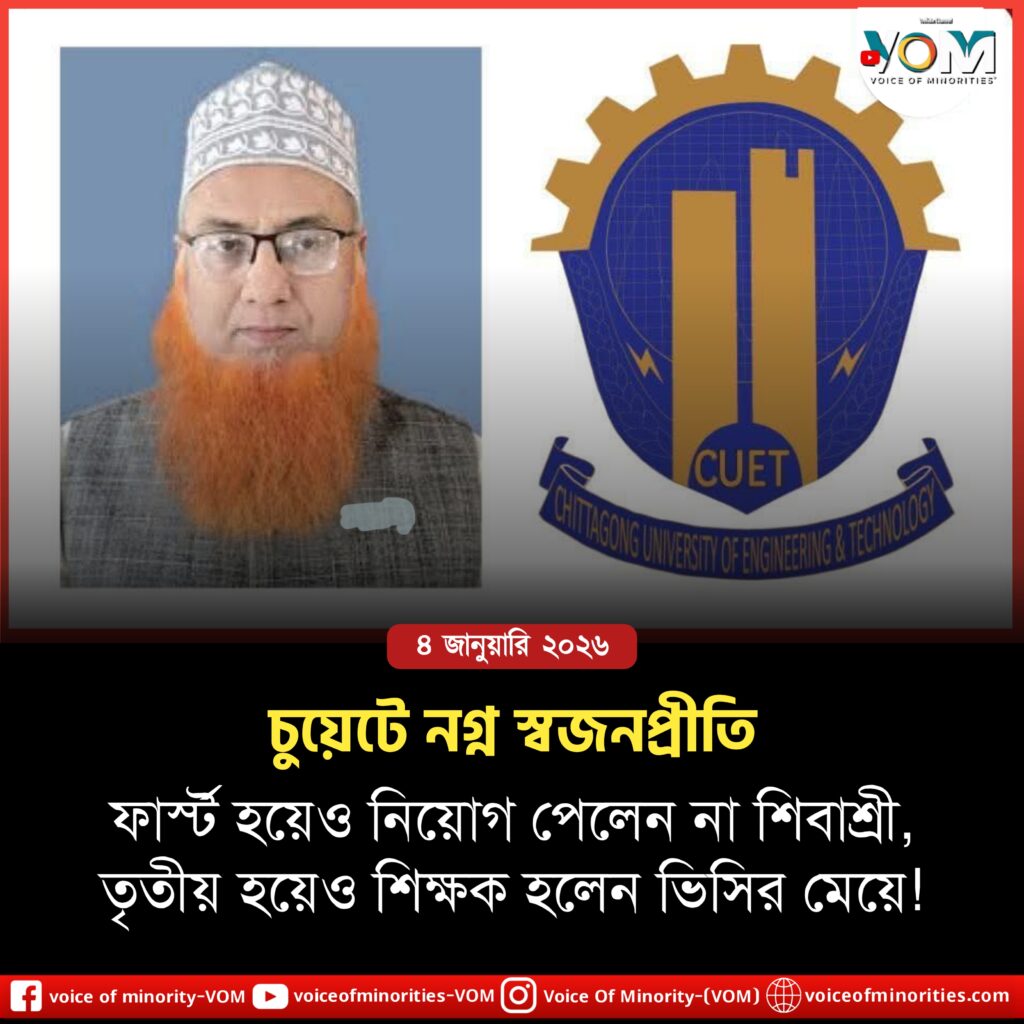
03 January 2026, Voice of Minority-VOM:- Chattogram, Bangladesh — Serious allegations of irregularities and nepotism have surfaced at the Chittagong University of Engineering and Technology (CUET), placing the university’s faculty recruitment process under intense scrutiny. The accusations are directed at the institution’s Vice-Chancellor, Dr. Abdul Matin, who is alleged to have influenced the hiring process to secure a teaching position for his daughter, bypassing candidates with higher academic merit.
According to multiple student sources and campus insiders, the recruitment process in the Electrical and Telecommunication Engineering (ETE) Department deviated sharply from long-established academic norms practiced across Bangladesh’s public universities. Traditionally, candidates who secure the first and second positions in departmental merit lists are given priority for faculty appointments. However, in this case, those conventions were allegedly disregarded.
Merit-Based Norms Allegedly Undermined
At the center of the controversy is Jerin Tasnim Maimuna, a graduate of CUET’s 19th batch in the ETE Department, who reportedly ranked third in her cohort. Students allege that the recruitment process was deliberately structured to facilitate her appointment, despite the availability of higher-ranked candidates from earlier batches.
Sources claim that a top-ranked student from the 18th batch—who had secured first position in the departmental merit list—was systematically excluded from appointment to make room for the Vice-Chancellor’s daughter.
Mysterious Cancellation of Recruitment Board
The controversy deepened following the cancellation of an earlier recruitment process. On November 11, 2024, CUET published a circular to appoint two lecturers in the ETE Department. Candidates from the 18th batch, including the first and second merit holders, applied and successfully cleared both written and viva examinations.
However, just before the final selection was announced, the recruitment board was abruptly dissolved without any publicly stated or credible explanation. Students allege that the decision was intentionally taken to delay the process, as the Vice-Chancellor’s daughter was not yet eligible or academically prepared at that time.
Fresh Circular, Familiar Outcome
A new recruitment notice was later issued on July 29, 2025, this time for three lecturer positions in the same department. Although the first-ranked candidate from the 18th batch reappeared for the selection process, she was once again denied appointment.
Instead, CUET appointed three candidates from the 19th batch—those ranked first and second, along with the Vice-Chancellor’s daughter, who ranked third—effectively sidelining higher-merit candidates from the previous batch for a second time.
Campus Reaction and Growing Discontent
Several students, speaking on condition of anonymity, expressed deep frustration and anger over the incident.
“This is not merely favoritism; it is a blatant abuse of power,” said one student. “Denying top-ranked candidates to accommodate a less-qualified applicant undermines the principles of fairness, transparency, and academic integrity. It damages the credibility of the entire institution.”
Faculty recruitment, students argue, should reflect merit, not personal influence—especially at a leading engineering university with international academic standing.
Reputational Concerns and Calls for Investigation
Education analysts and campus observers warn that such allegations could severely harm CUET’s reputation both nationally and internationally. The involvement of a Vice-Chancellor in alleged favoritism raises serious ethical questions and threatens public confidence in higher education governance.
Students are now demanding:
-
Immediate cancellation of the disputed appointments
-
Formation of an independent and impartial investigation committee
-
A transparent, merit-based recruitment process in line with public university norms
Without accountability, they fear the incident may set a dangerous precedent for politicized and nepotistic recruitment practices across Bangladesh’s higher education system.